May
The Year I Became Snail Mail Superstar

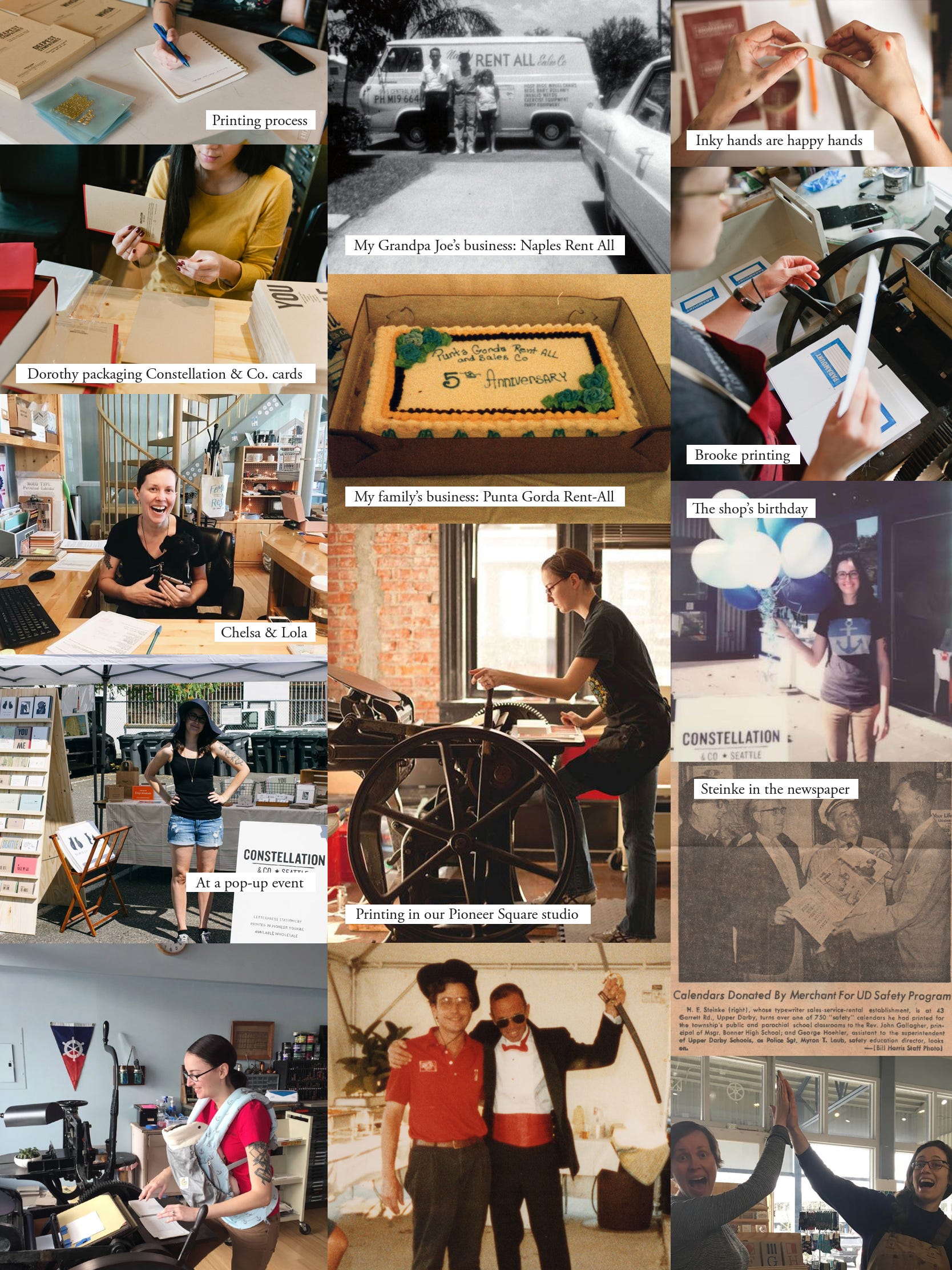
I grew up in a small business. My parents owned and operated their own equipment rental business for nearly thirty years. As a child, I was content to hide away in a back room drawing pictures, practicing different styles of handwriting, and playing with office supplies. I much preferred playing pretend with a legal pad and pen than with traditional children’s toys. I didn’t have much interest in the particulars of the family business, although I did learn to assemble a chain saw as a result of Hurricane Charley in 2004, which gave me some bragging rights.
I can see how growing up in the family business sowed seeds in me that would sprout and bloom later in life. I’m quite grateful that my parents modeled entrepreneurship for me when I was a child. When faced with setbacks in my career, starting a business of my own seemed like an obvious decision. I can recognize now that not everyone has that thought process. My parents have also been hugely supportive of my business, from its fledgling stage to today.
The first year I opened my brick-and-mortar store, I really didn’t know what to expect. Some of this was due to being new in retail, and some it was due to opening a shop without doing all that much research. I’ve always been a learn as I go kind of person. This is partly due to a bone deep impatience that life has been trying to help me grow out of since the moment of my first breath. It’s also, primarily, due to the fact that I will go ahead and do the thing I want to do, even if the research tells me not to. As Han Solo would say, “Never tell me the odds.”
I was going to open a brick-and-mortar shop, because it’s what I wanted to do and what I believed was the best next step for my business. My hastily-researched plans often work out, not because I’m lucky or particularly smart, but because I’ve got no quit in me. If it’s what I want to do and something I believe in, I will keep doing it, forever and ever, amen.
Now, that doesn’t mean I keep doing the same thing over and over again and expecting different results. That’s insanity. No, my stick-to-itiveness is not purely stubbornness, but is paired with a commitment to flexibility.
I spent the years of my life between 2 and 18 years old in a ballet studio. I learned technique, choreography, and performance skills. I was not naturally talented, and flexibility didn’t come easily to me. Ballet, without flexibility, is pretty depressing to watch. You can have the nicest feet and the most beautiful artistic expression, but, without flexibility, the steps and poses just don’t look right–plus, flexibility keeps you from hurting yourself.
You can learn a new piece of choreography quickly, but you can’t gain flexibility overnight. It takes consistent, everyday work. Over time, you stretch and reach just a little bit farther each day. Eventually, you’re able to elongate your limbs farther and kick your legs higher. Flexibility turns an aspiring dancer into a ballerina.
Our first official year in business, I was given a major opportunity to be flexible. In the first days of 2011, I signed a lease on my first studio. It was a hundred square foot, windowless space that had previously been an amateur porn studio. It wasn’t perfect, but it was mine. On move-in day, I hummed a happy tune while carefully throwing away the items the previous tenant had left for me: an empty vodka bottle, a razor blade, a single medical glove, and several cups of cat food that I discovered when it rained on my head as I removed a hanging shelf. I scrubbed and painted the space until it was gleaming. It was my pride and joy.
My studio was in a ramshackle old building, built in 1911 in the historic Seattle neighborhood of Pioneer Square, located at 619 Western Avenue. We just called it 619. It had six floors of artists’ studios, an old-school elevator with a metal cage, and a huge crack in a major supporting wall that started up on the sixth floor. According to the Seattle Times, it was, until 2011, the largest single collection of artists on the West Coast.
The building terrified my parents when they came to visit, but I was in love. I paid around $300 a month for my tiny artist’s studio space. I spent long days there by myself, cleaning, painting, and decorating every square inch. It was easy to lose track of time there with no windows to betray the sun’s position in the sky.
When I bought my first printing press, we loaded it onto the freight elevator and made the harrowing journey up six floors. The building had settled over time, and the wood floors sloped wildly in different directions. My press was around 500 lbs., so we used an ancient method of moving heavy things: rolling it along the floor on a series of steel tubes. The plan was going well until we came to a narrow doorway. We couldn’t widen the doorway, so we had to make the press more narrow.
Fortunately for me, my press was a total bargain at $500. Unfortunately for me, it had been stored for years in a damp Seattle garage next to a washing machine and was covered in rust. The journey of Josephine the Printing Machine had come to a halt for that day. I came back every day for a week with a can of penetrating oil, spraying down the parts until we could get the fittings to budge. Eventually, we were able to remove the press’ flywheel, making the press narrow enough to pass through the doors.
My press finally made her triumphant entrance into the place I’d prepared for her, pushed by myself and my mentor, Carl Montford. Carl is one of the most generous people I’ve been lucky enough to meet. He gives freely of his time, resources, knowledge, and affection. He helped me move my first press, taught me wood engraving, and lent me his van to move my iron handpress. I owe him more than I can ever repay.
That day, Carl took a cell phone video of me guiding the press along the steel tubes, and another video of me running the press for the first time after we’d put her back together. Phone camera technology has improved a lot since 2011–and I look like a total nerd in the grainy videos–but I still like to go back and watch them. The woman in the videos is young, hopeful, and happy.
This outcome–my press, in my studio, up and running–felt like such an impossibility while I was in the middle of the process. It didn’t come together in the time frame I wanted, or without some heartache, but with patience and flexibility, it happened. I vowed to never move a press again and made my husband promise to bury me there, in the floorboards next to the press.
I’m giving you all of this back-story right now because I want you to understand the feeling that overtook my body when I found out that, after seven months in the building, I had two months to find a new place and move out. As it turns out, the 2001 Nisqually earthquake had left the huge cracks in the 619 building. The damage had, pun intended, slipped through the cracks of the relevant government agencies and had never been addressed. When the Washington State Department of Transportation was preparing to dig the huge tunnel to replace the Alaskan Way Viaduct, they realized that the 619 building was directly in its path and would likely be unsafe with the rumbling of Bertha underneath.
Who is Bertha? Why, she is a fifty-seven-foot-diameter tunnel-boring machine built specifically for the tunnel project. The coming of Bertha meant the going of artists from 619; however, it also meant displacement funds from WSDOT. As an officially registered business, I was eligible to receive financial help for moving into a new space. I wasn’t happy I had to leave so quickly, but the money really helped to establish my business. Looking back, I’m grateful for that turn of events.
The tunnel was finally completed and opened in February of 2019. The day of its grand opening, the Seattle skies opened and dumped eight inches of snow on the city. The ensuing snow day was a cozy, magical day that I used to edit the manuscript of this book. I simply can’t help myself and must include this non-essential information because it feels so satisfying to share the perspective of current-day me. A month or so later, I drove through the tunnel for the first time and got a little clammy with claustrophobia. I won’t be making it a habit.
If you knew me in the summer and fall of 2011, I apologize for the stress monster you spent time with. It was a wild few months. Thankfully, I was evicted in good company. Each floor of 619 had a different landlord, and up on the sixth floor we had a landlord who was a woman on a mission.
Artist and badass business lady Jane Richlovsky found an empty floor of a historic building just a few blocks away and put in the hard work to make it a place for artists. She used her relocation funds for the development of thirteen new studios out of a vacant office space at First Avenue and Cherry Street. I, along with several other artists from 619, pooled our benefits to help with remodeling costs. We had many work nights, pitching in to paint, refinish flooring, and finish up the space. Jane named the new collective “’57 Biscayne” from a line in the Joni Mitchell song Raised on Robbery that references eminent domain.
It was an honor to witness and be a part of Jane’s mission to keep artists in Pioneer Square. She’s a force of nature. In 2015, Jane gave a TED talk at Penn State about “the need for artists to shake the popular perception of themselves as victims and to do something to prevent their own displacement from the urban centers they helped make ‘cool’ (and expensive).” Later in 2015, she found willing partners with common interests and was able to buy the building housing ’57 Biscayne and keep it affordable to the arts for many years to come. If, as I’ve discovered, both business and life are about being flexible in the face of hardships and making something beautiful out of them, Jane is an expert. I’m very glad I got to spend time with and learn from her.
I spent three years doing business in my beautiful studio at ‘57 Biscayne. If working long hours and putting in elbow grease made me love the little space at 619, I had a full blown, passionate love affair with my new space at First and Cherry. For those three years, I pretty much lived there. If friends wanted to hang out with me, they came to the studio. The owners of the restaurants nearby came to know us by face and by name. I worked days, nights, weekends, and whatever came between. I napped there. I taught workshops there. I hosted a ladies’ Bible study there for a little while. I bought furniture to fill out the space. Brad and I built custom bookshelves for the walls. My first employees worked there. The business transitioned from custom wedding invitations to greeting cards and wholesale there. It was a good place.
Right around the time that Brad and I were finishing up the adoption process in the fall of 2014, I was getting antsy for a change. I wanted to expand to retail, and I wanted to be closer to home. It was time to be flexible again. Constellation & Co. moved to the Fishermen’s Terminal, I opened the brick-and-mortar shop, and faced a new set of challenges.
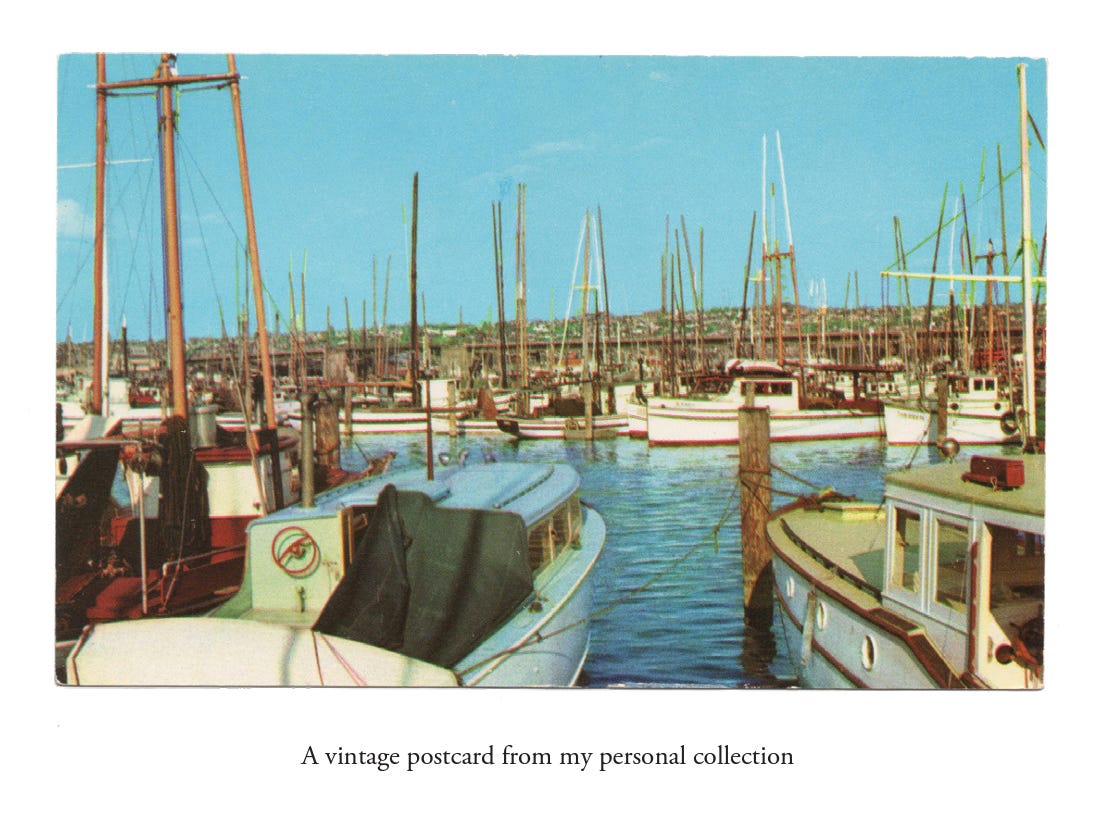
Each year on or around May first, Constellation & Co. has a big “May Day” sale. In an effort to make this book super juicy, I will now reveal to you the secret double entendre that inspired the annual sale during our brick-and-mortar shop’s first year. I want you to really get your money’s worth with this book. I’m thoughtful like that.
May Day is, as a holiday, an ancient Northern Hemisphere spring festival and a traditional spring holiday. I remember my mom talking about making May Day baskets to leave on the neighbors’ front doorsteps as a kid.
May first is also celebrated as an international day honoring workers. For the last few years in Seattle, it’s also been a day for “anarchists” to smash the windows of the Nike store downtown while wearing Nike shoes. Now, the Nike store boards up its windows in advance. It’s a bizarre phenomenon.*
If you squish the two words May and Day together to be Mayday, it’s an emergency procedure word used internationally as a distress signal in voice-procedure radio communications.
Spring can be really slow for retail. The holiday rush stretches into January a little bit, and Valentine’s Day gives the early year a little boost, but March through May can be rough going. Spring in Seattle is gray, cold, wet, and stretches out until about July fifth. The joke in Washington State is that summer officially starts on July fifth, because on July 4th–the Independence Day holiday and a stereotypically lovely summer day everywhere else–the weather is always terrible here.
In 2015, our shop’s slow first spring had me really scared. We were just barely making ends meet. The weather outside was rough. I was still figuring out how to manage a team, and still discovering what items and price points worked for the shop. In that season, we weathered days of no sales and sale amounts in the single digits. There are few things that make a shop owner panic more than seeing the end of day sales total ring up at two dollars. At least those two single dollar bills can keep each other company. That first spring, I still had a newborn at home, so I couldn’t downsize the team or pick up any extra shifts. It was beginning to feel like an emergency. I was in distress, so I called for “mayday” procedures.
Just a few days in advance, I scheduled a big sale event and called it the May Day Sale. Okay, okay, okay. I know what you’re thinking. Having a sale is not an innovative business strategy. No one is going to be inviting me to give a TED talk about how sale events encourage shoppers to come out and spend money. But here’s the thing–I’d never had an in-person sale before. On that May first, I brought out our misprinted and slightly damaged cards for people to buy for one dollar. I discounted slower moving items to clearance prices. I gave it a try.
The day of the sale, our team saw more people in the shop than we’d seen in weeks. People were excited to make a trip to the shop just because something fun was happening. It felt like a community event. People brought their friends and stood around chatting with us. On that first May Day-mayday sale day, I looked around and people were smiling. I was smiling too. We made money that day. But more than that, we boosted morale, both for our team and our customers.
We’ve hosted the sale every year since. It’s one of my favorite days of the year at the shop. Our customers look forward to it. I save up goodies all year to put on sale for that one day. It’s become a symbol for me, of taking lemons and making lemonade. I turned mayday distress into a May Day celebration in 2015. I was flexible and tried something new to get a different outcome. I didn’t give in to fear, but stepped out in confidence. I’m proud of our May Day Sale, and it makes me smile knowingly each year when we open the doors to greet our excited customers. And now you know why.
*There is no longer a Nike store in downtown Seattle.
For many years, the National Stationery Show was held in May of each year at the Javits Center in Manhattan. It’s a wonderland of paper goods, held in a giant glass castle of an exhibition center in New York City. As my business transitioned from custom designs to greeting cards and wholesale, exhibiting at the show became a major dream and goal of mine.
In 2013, I attended a weekend workshop called Paper Camp put on by Katie Hunt of Proof to Product. That experience gave me a new community and tons of practical information. It also helped to super-charge my confidence. If other people could do this, I could do it too. I didn’t feel alone in my industry anymore.
I exhibited at the National Stationery Show for my official wholesale debut in May 2014. It was just my second trip to New York, a lifelong dream in and of itself. I met other small business owners I knew from Instagram and many of my stationery industry idols. I walked back to the hotel after the show each evening with feet that screamed in pain from a day of standing and a face that was sore from all the smiling. It was an absolute joy. I didn’t know what to expect, but I felt great about the new wholesale accounts I’d gained at the show and the progress I’d made toward my dream job. Looking back, I can say with full confidence that my first show was a major success.
I exhibited at the show again in 2016. This time, Brad and I took kiddo with us, and Brad’s mom flew from Florida to meet us there and help out. I’ll always remember seeing my son run with tiny toddler steps up the brightly colored aisles of the trade show, excited to see me. It was technically against the rules to have kids at the show, but I don’t regret it one bit. We are a family business, and he’s a huge part of my family.
At the National Stationery show in 2016, I won a Best New Product award for a series of nautical flag postcards featuring the International Code of Signals. It’s a bizarre and wonderful feeling to be handed a trophy as an adult. Awards don’t say everything about one’s success in business. In fact, I refuse to pay for industry award submissions. I just won’t do it. But it feels pretty damn good to receive an award, nonetheless. It’s been a few years, but I still have the little glass trophy displayed on my desk at home. It’s a tangible thing to point to when my brain is being a jerk. On bad days, I like to tell my brain, “See! I won an award once. I’m not a total failure.”
In May of 2018, I made the cross-country trek to New York in order to shop the National Stationery Show, choosing items for my brick-and-mortar store. I took a red-eye, spent a whirlwind day in Manhattan meeting people, and making a series of videos for my YouTube channel. A diehard group of friends and fans helped to crowd-fund my travel expenses for the trip, and their support gave me the feeling of being sent with love. I was eager and excited to capture every moment to share with these beautiful people who were willing to support my physical and metaphorical journey.
I flew home exhausted, but exhilarated. New York makes me feel small in the best way. I headed home inspired and antsy to edit my videos and share them. Unfortunately, I arrived home to a world that was forever changed.
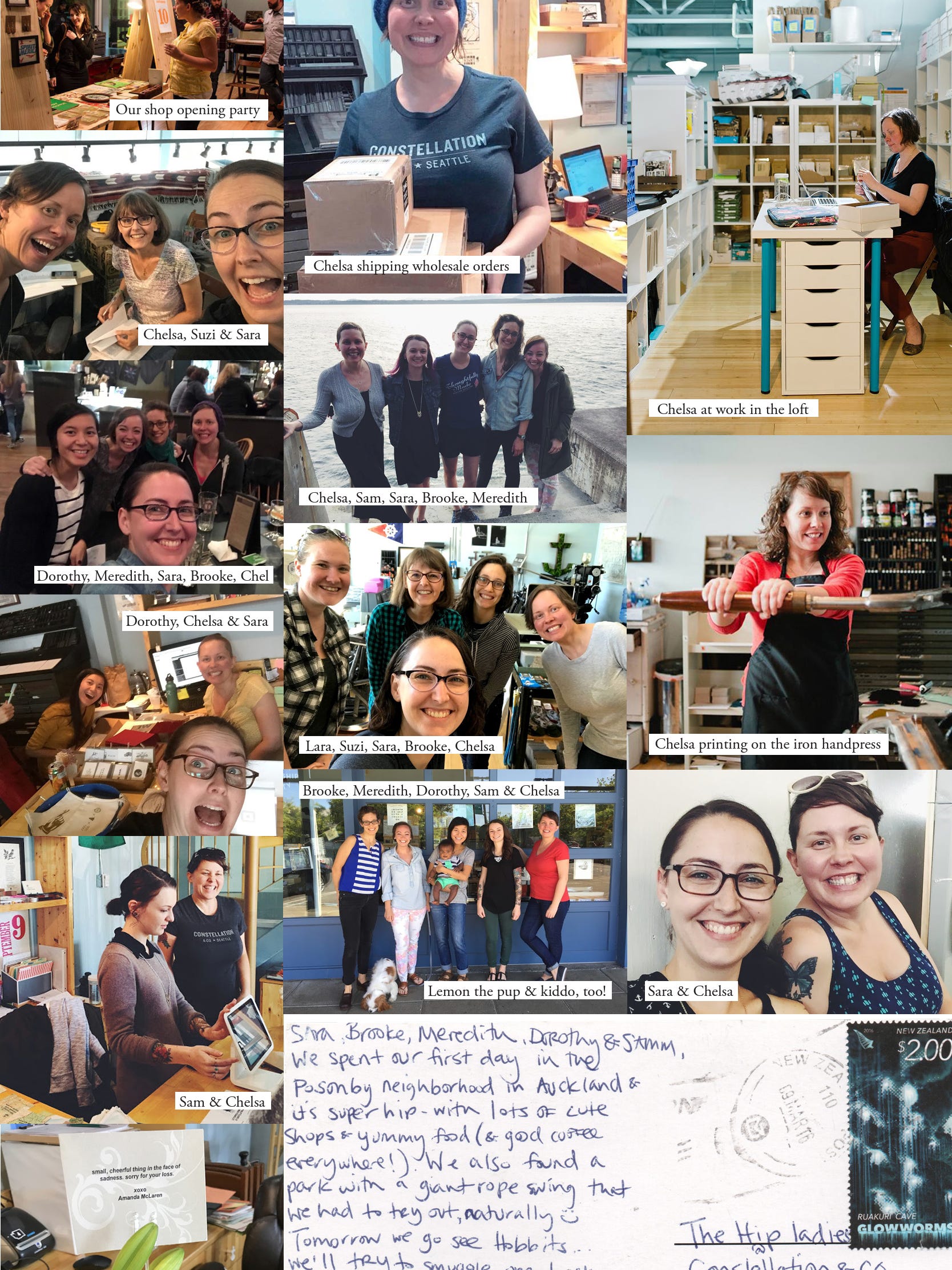
In May of 2018, I lost my dear friend and longest tenured employee, Chelsa. I wish you could meet her. There’s never been, and never will be, another person like her. In her absence, I’m left with the honor of sharing a small piece of her story.
Chelsa married her wonderful husband, Matt, in December of 2010. In March of 2011, she was added to his health insurance and went in for a routine physical. In May, after a lot of testing, she was diagnosed with multiple myeloma, a cancer of the blood plasma cells.
I met Chelsa in August of 2012. Mutual friends from church were hosting a house party benefit to raise money for her cancer treatment. I brought art prints and cards to add to the silent auction. I’d heard about Chelsa from several friends. I wanted to meet her, but I felt weird about introducing myself on that particular evening. I did it anyway. I gave her an art print that Brad and I had made for Brad’s dad when he was going through cancer treatment. She accepted it with warmth and made me feel like I was already her best friend in that very first conversation. She had that effect on people. I was used to feeling uncomfortable and out of place when meeting new people, but she made me feel right at home.
In 2014, Matt and Chelsa were in a weekly church dinner group with Brad and I. My business had been growing, and I was excited to try taking on a new part-time employee. Chelsa had taken a break from working while she went through cancer treatment. We got along really well and the position was super flexible, so I asked Chelsa if she was interested. We got together shortly thereafter to chat and I showed her around the shop. On July 18, 2014, I sent her this message on Facebook: “Hello! I’ve got good news. The job is yours if you want it!” She responded, “Woohoo!! I do, I do!!”
Chelsa was there when we moved Constellation & Co. from our downtown studio space to the Fishermen’s Terminal in October of 2014. She warmly greeted people on the first day we were open and became the face of the brick-and-mortar shop for our customers.
When our son was born in Florida, Brad and I spent a full month out of state. Chelsa stepped up in a big way. She managed the shop, shipped wholesale orders, and helped lead the Constellation & Co. team. Chelsa was in the shop on the day I brought my son to work with me for the first time. She was always there. She held my son so I could use the bathroom. She brought the team snacks and gifts. Her smile and laugh filled the shop like sunshine.
Chelsa loved my business as much or more than I did. She spoke of our products, our team, and our mission with affection and passion. She could sell rings around the rest of us, just by being her lovable, friendly self. She was, as a rule, patient and compassionate with everyone who came through the door. Even the most rude and disgruntled customers received the best of her. Someone would leave, and as the door closed behind them, she’d say, “That’s my new best friend,” or, “Love ya, mean it!” Whether you were kind or rude to her, she really did manage to love ya, and mean it.
Chelsa had an eclectic, fun sense of style. She loved to go thrift shopping. She loved Lord of the Rings. She loved her squish-faced cat, Roberta. She was kind to my weird dog who liked to unexpectedly jump into her lap at the shop’s front desk. She adored her nieces and nephews and would tell me with excitement and anticipation that they were coming in to visit that day.
Chelsa was with me one evening when I checked an item off my bucket list. Together with Matt and Brad, we went to see the Johnny Cash cover band Cash’d Out at the Tractor Tavern. I began a lifetime love affair with the music of Johnny Cash in college and had always wanted to see it performed live. That night was magical, drinking whiskey and hearing those songs I adore. I’ll never forget it.
The years that Chelsa was in my life were full of tumult for me. Brad’s and my church home of five years had fallen to pieces around us and after a long period of waiting it out, we decided to leave. In doing so, we walked away from nearly the entire community we’d built in the first five years we’d lived in Seattle. At the same time, we were going through the first years of infertility and wading into the adoption process. We became new parents while I was running a rapidly growing business. All of these factors added up to a sense of isolation in my life. Chelsa (and the rest of our team at the time: Meredith, Brooke, Dorothy, and Sam), were my support system. Chelsa held us all together and made our team feel like a family.
Chelsa and I logged countless hours in soul-deep conversation. I have so many memories–one of us halfway up the spiral staircase in the shop, pausing the day’s action to hear about what the other was going through. We spoke the same language of grief. Our relationship held space for confusion, doubt, hurt, anger, and dark humor. It was safe to feel my feelings with her. In many of my other relationships, my negative emotions were treated like a plague to be avoided, but Chelsa understood. She spoke the truth of her struggle, too. She was the most honest person I’ve ever met, and she could speak strong words when the situation called for it. She was also the most hopeful person I’ve ever met. Hope and struggle weren’t opposites in Chelsa’s world. They lived side by side, always.
Chelsa was my lighthouse. What do you say about your constant? What words are there to describe a person in your life that is always there? Knowing and loving Chelsa was like breathing. You just did it. She was easy to love, and loving her made everything better.
I never imagined a world without Chelsa. She was an anchor in my life’s stormy seas. I knew she was sick. She’d been sick as long as I’d known her. Several times, she texted me late at night before her shift the next day to let me know she was in the hospital. A few times, it was really bad and the texts came from Matt. Our team at the shop would worry, hope, and band together to keep things running in her absence, but it was always temporary. In the time since she’d been diagnosed, medical science had been working on a cure and was getting close. She was working toward that eventuality. We were all so sure.
I wish I’d had a greater sense of urgency; but life isn’t lived looking back. We never made a plan for what to do if she didn’t come back to work. I never really worried about what that empty chair would look like or feel like. My lifelong battle with anxiety means I worry about everything; I picture every worst-case scenario, hear bad news in my ears in preparation, but I never went there with this. People in their thirties are supposed to live. They’re supposed to have kids if they want to. They’re not supposed to leave their spouses widowed. Chelsa died on Wednesday, May, 23, 2018. Her absence is a chasm.
After my quick trip to New York in May of 2018, I flew back to Seattle and took the light rail to my favorite taco place for lunch. I hadn’t been back to my house yet and still had my suitcase with me. I was lifting a taco to my mouth when I got a text from Matt: “I just wanted to let you know that we’re saying goodbye to Chelsa right now. I know she loves you a ton and just wanted you to know.”
I ugly cried into my plate of tacos. I tried to call Brad at work, but he didn’t pick up. I called my mom, because that’s what you do when you’re a kid and you need someone to fix something that’s broken. I didn’t know what to do. I talked to Brooke and Meredith and tried to get down to the shop to see them, but traffic was awful and I couldn’t make it in time. I picked up my son from school, sat with him on the couch, and tried to be okay.
On the plane trip home, I’d worked on a little hand-illustrated book for him about my New York trip. He struggles with big feelings when we’re apart, so I like to tell him the story of where I’ve been so he’ll understand and feel better.
On one page of the book, I’d drawn a stick figure of mommy crying because she missed her kiddo while she was gone. He kept opening the book to that page, pointing at the drawing, then pointing at me saying, “Mommy is sad! Mommy is crying!”
I tried to be okay. I wasn’t okay.
There was no one else to work at the shop the next day, and it didn’t feel right to be closed, so I went to work. I called in a favor from my mom and asked her to come with me. It didn’t feel right to be alone.
I sat in my car for a while, staring at the front of the shop. I began repeating an internal mantra: “I just have to get through the next five minutes. I just have to get through the next five minutes.” I’ve pulled those words out as a coping mechanism many times before and since, but this was the time I most needed it to be true.
Unlocking the door and going inside the silent shop felt terrible. I felt her presence and her absence so completely, I could hardly breathe. She was still so very there. Her folder was still in the box on the desk. Her name was still on her cubby upstairs. Her handwriting was on things everywhere. Her tub of disinfectant wipes stood guard over the place.
Have you seen the musical Les Misérables? I grew up loving it. I felt kinship with the female characters, their loves and heartaches and hope for the future. I saw it again at The Paramount Theatre two weeks after Chelsa died. I expected to cry. I did not expect that “Empty Chairs At Empty Tables” would destroy my heart and become the background music in my head for the rest of the year. Now, when I think of Les Mis, I think of Marius grieving his lost friends, and I think of my lost friend.
I spent that whole first day, and many days after, waiting to hear her keys in the lock and the bell ringing on the door. She loved the shop, loved working there, and wanted to be there.
If ever I doubted, her husband, family, and friends have reassured me again and again: She loved us. She wanted to stay. And she’s gone.
It’s not okay. I can’t make it okay. I’ve survived each five minutes since that day, but the grief still hits me fresh again and again. For a while, Facebook said she’d be attending upcoming events. Gmail still suggests I include her in my staff emails, every single time. I want to text her, call her, see her.
In the weeks after Chelsa died, washed in the newness of grief, my moods were a wild pendulum. Sometimes I was so devastated, I was incapable of getting through the day as a productive human and without eyes swollen huge from tears. Other days, the beauty of life taking place around me was so sharp, I could hardly stand it. I wanted to feel everything, see everything, do everything. Life felt short and incredible, and I wanted all of it, right now. I’d eventually fall down from the high of those days, feeling guilty and gluttonous from imbibing so fully in my life, when my friend’s life was cut short.
May 29, 2018: I knew I needed therapy so I made this appointment. Now that I’m here, I’m nervous about talking through my grief. Grief is unpredictable and facing it is unbuttoning all the safeguards that hold me together. It takes me back to losing my Grandma Jean. It takes me back to losing Jesse and Sara. It’s grief that’s taken me almost 20 years to understand. I’m afraid of my grief. I’m afraid to be okay. I’m afraid to not be okay.
In this season, I wrote a lot of words about the nature of grief in my journal. I wasn’t ready to speak them or use them for anything when I wrote them, but they eventually became the new greeting card release for Constellation & Co. in the summer of 2018.
It’s a consistent phenomenon in how I write and create products. I’ll scribble something in my journal that feels true but is too scary to look at right away, or doesn’t feel good enough. I close the page, ignore the words, and come back to them later. It’s a weird little dance that my brain and I do, but it works for me.
In the days after Chelsa’s passing, I received flowers from my friend Amanda, who lives in Toronto. The included card read, “Small, cheerful thing in the face of sadness. Sorry for your loss.” It was a lovely sentiment for a bouquet of flowers from someone who loves me. It was just as perfect of a sentiment for the cards I write and the products I make.
The things I make are small, and hopefully they bring cheer to the person who receives them. They’re not typically flashy or fancy or funny. They’re just little things on a mission to stand watch in the face of sadness. I want my cards to shine like a lighthouse and cut through the dark to connect those struggling to the people who love them. I taped the floral card into my journal as a reminder of my mission.
Chelsa is still my lighthouse. I think about her in every decision I make. Past members of my team who knew her reach out to tell me she’d be proud of me. We’re still finding her words of love, written on the sticky notes she adored, months after she’s been gone. The most recent one we found said, “Love you, boo bear. <3, Chel.” We love you too, friend.
“Only grieving can heal grief; the passage of time will lessen the acuteness, but time alone, without the direct experience of grief, will not heal it.” –Anne Lamott, Traveling Mercies: Some Thoughts on Faith
Want to read ahead? The kindle version of my full book is available here.